The message often arrives without warning.
A hospital is hiring nurses urgently. A diagnostic centre needs laboratory technicians. A private clinic is looking for doctors. The salary appears attractive, the joining date is immediate and the person sharing the vacancy claims to have direct access to the employer.
The opportunity may arrive through a WhatsApp group, a social-media post or an unsolicited phone call. Sometimes the recruiter asks for a résumé. Sometimes the conversation moves quickly to registration fees, interview charges, security deposits or payments supposedly required to “confirm” the position.
For healthcare professionals searching for work, particularly those who need a job urgently, the distinction between a genuine opportunity and a misleading offer is not always obvious.
India’s healthcare employment market is large and fragmented. Hospitals, clinics, nursing homes, diagnostic centres, rehabilitation facilities, home healthcare companies and medical colleges recruit through many different channels. Some advertise on their own websites. Others depend on job portals, recruitment firms, professional networks, local consultants and informal referrals.
That variety creates opportunity. It also creates confusion.
A candidate may encounter the same vacancy in several places, with different salary figures and conflicting descriptions. The name of the hospital may be withheld until a payment is made. An intermediary may claim to be acting on behalf of an employer but offer no official email address, written job description or evidence of authorisation.
For candidates, the challenge is no longer simply finding a vacancy. It is determining whether the vacancy is real, current and connected to an identifiable employer.
That is where a healthcare-focused platform can play an important role.
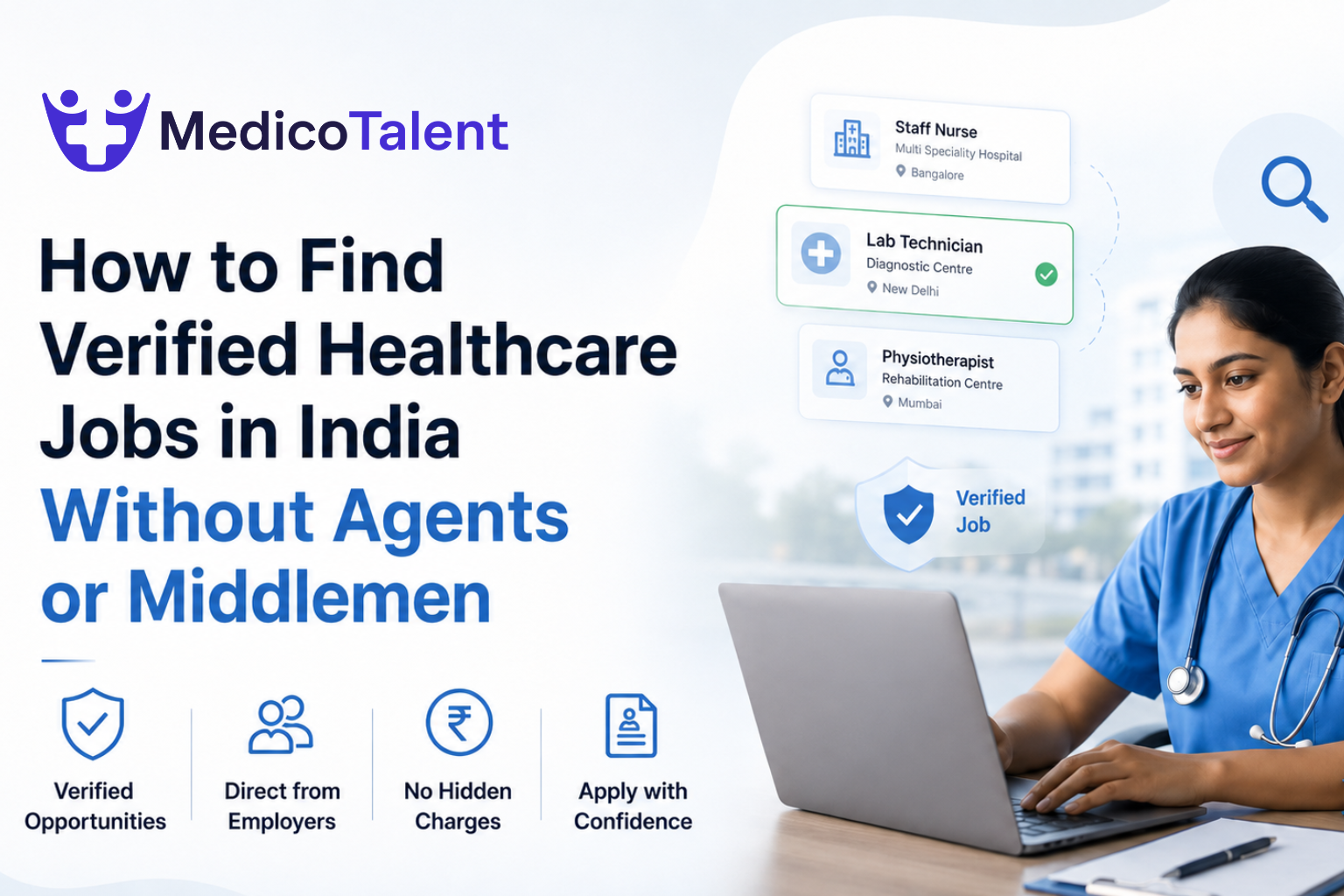
MedicoTalent was created as a dedicated healthcare job portal connecting doctors, nurses and allied healthcare professionals with hospitals, clinics, long-term care providers and other healthcare organisations. The platform is designed around transparent recruitment, direct applications and healthcare opportunities without hidden charges, misleading promises or unnecessary middlemen. Registration and job applications are free for healthcare professionals.
Still, even when using a specialised platform, candidates should understand how job verification works—and what questions to ask before accepting any offer.
What a verified healthcare job should look like
The word “verified” is used frequently in recruitment. It can mean different things depending on the platform, employer or agency using it.
For a candidate, a verified vacancy should, at a minimum, be connected to an identifiable organisation and contain enough information to evaluate whether the opportunity is credible.
A legitimate healthcare job advertisement will usually include:
- The employer or healthcare organisation’s name
- A specific job title
- The job location
- Required qualifications
- Required professional registration, where applicable
- Experience expectations
- Key responsibilities
- Employment type
- A clear application method
- Contact information connected to the employer or authorised recruiter
Not every genuine employer publishes its salary. Not every hospital writes a detailed advertisement. Smaller clinics may have limited recruitment resources and use simpler job descriptions.
But vagueness should have limits.
A message that says only “Urgent hospital vacancy—high salary—contact immediately” gives the candidate almost nothing to verify. A recruiter who refuses to identify the hospital, explain the role or provide written details should be treated cautiously.
The more information a candidate has, the easier it becomes to check whether the employer exists, whether the role matches the organisation and whether the person communicating about it is connected to the hiring process.
Why middlemen remain common
Healthcare recruitment frequently involves specialised requirements. Hospitals may need candidates with particular registrations, clinical skills, language abilities or departmental experience. International positions can involve licensing examinations, document verification and immigration procedures.
These complexities create space for legitimate recruitment firms and consultants. They also create opportunities for unaccountable intermediaries.
The problem is not that every recruiter or agency is dishonest. Many employers use professional recruitment support because they lack the time or internal capacity to source candidates directly.
The problem arises when candidates cannot determine who the intermediary represents, what service is being provided or why money is being requested.
Some middlemen rely on information gaps. They may take a publicly available vacancy, circulate it in private groups and present themselves as the exclusive route to the employer. Others may promise interview selection, guaranteed placement or an appointment letter in exchange for payment.
A legitimate recruiter may help arrange an interview. A recruiter cannot guarantee that a hospital will hire a candidate before the hospital has assessed the person’s qualifications and suitability.
Healthcare professionals should be particularly cautious when someone promises a confirmed job without a formal application, credible interview or document-verification process.
Begin with the employer, not the promise
Before applying, search for the employer independently.
A hospital’s official website should usually provide its location, services and contact details. Larger organisations may have a careers page. Smaller hospitals and clinics may have a limited online presence, but their address and telephone number should still be reasonably consistent across credible sources.
Look at the email address used by the person contacting you.
An official organisational email address is generally more reassuring than a personal address. But it is not conclusive. Some smaller healthcare employers use common email services, while fraudulent actors can create addresses that closely resemble legitimate domains.
Do not rely on the email address alone.
Call the healthcare organisation using a telephone number found independently—not only the number supplied in the message. Ask whether the vacancy exists and whether the named recruiter or agency has been authorised to hire for it.
This small step can resolve many doubts.
Candidates are sometimes reluctant to contact the hospital because an intermediary has warned them not to do so. That warning itself should raise concern. A genuine recruitment process should not depend on preventing candidates from confirming that the employer is actually hiring.
Read the job description carefully
Fraudulent and misleading vacancies often rely on urgency rather than detail.
The candidate is told that the position must be filled immediately, that only a few places remain or that payment is required before the opportunity disappears.
A legitimate healthcare employer may indeed have an urgent requirement. Staff shortages are real, and hospitals sometimes need to recruit quickly. But urgency does not remove the need for a proper job description.
Check whether the responsibilities make sense for the title.
A staff nurse position should describe the department, patient-care responsibilities, shift expectations or clinical requirements. A medical laboratory technician role should mention relevant laboratory duties and qualifications. A physiotherapist vacancy should indicate the clinical setting or type of patients being treated.
Be cautious when the salary appears unusually high for the experience requested, especially when the employer remains unnamed.
An attractive salary is not proof of fraud. But when high compensation is combined with minimal eligibility requirements, immediate selection and requests for payment, the risk increases.
Never pay simply to apply
Candidates should be extremely cautious about paying application fees, interview fees, registration charges or deposits to an unknown person.
There may be legitimate costs associated with professional registration, medical examinations, credential verification or government documentation. Those payments should normally be made directly to the relevant authority, institution or clearly identified service provider.
They should not be transferred casually to an individual’s personal account merely because that person claims the payment is required for employment.
Ask for:
- A written explanation of the charge
- The name of the organisation receiving the money
- An official invoice or receipt
- A refund policy, where relevant
- Independent confirmation from the employer
Do not share one-time passwords, banking PINs, card security codes or online banking credentials. A legitimate employer does not need these details to process a job application.
Candidates should also be cautious about sending identity documents too early. A résumé and professional-registration details may be appropriate during an application. Copies of passports, identity cards, bank documents and certificates should be shared only when there is a clear, legitimate reason and the recipient has been verified.
A real interview should involve real assessment
Healthcare employers carry significant responsibilities. They must assess qualifications, professional registrations, clinical experience and suitability for the role.
A credible interview process should reflect that responsibility.
The interviewer may ask about:
- Previous workplaces
- Clinical departments
- Patient-care experience
- Equipment or procedures
- Professional registration
- Shift availability
- Communication skills
- Reasons for changing jobs
- Expected salary
- Joining availability
The precise process will vary. Some employers conduct several interviews. Others make decisions after one structured conversation, particularly for urgent or junior roles.
But candidates should be cautious when there is no meaningful assessment at all.
A brief text exchange followed immediately by a demand for payment is not a credible hospital recruitment process. Nor is an “interview” in which the candidate is asked no questions about qualifications, experience or the job.
Video interviews can be legitimate, particularly when the candidate and employer are in different cities. Candidates should still know who is interviewing them, which organisation the person represents and what position is being discussed.
Why a healthcare-only job platform helps
General job portals contain vacancies from nearly every industry. They can offer large audiences, but healthcare professionals must often search through unrelated advertisements, loosely matched roles and listings that provide limited sector-specific information.
A healthcare-only platform narrows the environment.
MedicoTalent focuses on doctors, nurses, pharmacists, physiotherapists, dentists, dietitians, medical imaging professionals, laboratory technicians, occupational therapists, hospital administrators and other allied healthcare professionals.
This specialisation matters because the platform begins with a defined audience. Healthcare employers are advertising to people who are already searching within the sector, while candidates can browse opportunities aligned with their qualifications and professional interests.
MedicoTalent also aims to support direct connections between candidates and healthcare employers. Professionals can search for opportunities, create a profile, upload their résumé and apply without depending on an unknown agent to control access to the vacancy.
For job seekers, that directness provides more than convenience.
It creates a clearer record of the application. The candidate can see the advertised role, understand the stated requirements and apply through an established platform rather than sending personal documents through an informal chain of contacts.
Verification does not end when the vacancy is found
No platform should encourage candidates to abandon their own judgment.
Even when a vacancy appears on a recognised job portal, candidates should read the description carefully, research the employer and verify unexpected requests.
A job advertisement may have been genuine when first published but later filled or withdrawn. Employer circumstances can change. Details can also be misunderstood during follow-up communication.
Verification is therefore not a single stamp placed on a job. It is a process.
The candidate should confirm:
- The organisation exists.
- The vacancy is current.
- The person communicating is authorised.
- The qualifications and responsibilities are clearly explained.
- The interview process is credible.
- Any requested payment is legitimate and independently verifiable.
- The final offer is provided in writing.
A formal offer should identify the employer, job title, location, salary, employment conditions and expected joining date. Candidates should read every section carefully before signing or resigning from an existing job.
Be cautious with social-media and messaging groups
WhatsApp, Facebook, Telegram and other online communities can help candidates discover openings quickly. Hospitals, recruiters and employees sometimes share genuine vacancies through these channels.
But these platforms are not designed primarily for recruitment verification.
Posts can be copied, altered and recirculated long after a position has closed. Contact details can be replaced. An old advertisement can appear new because someone reposted it.
Use informal groups as a source of leads—not as the final source of truth.
When a vacancy looks relevant, look for the employer’s official posting or search for it on a recognised employment platform. Contact the organisation independently where necessary.
Do not allow the urgency of a group message to replace basic checks.
Build a profile before the opportunity appears
Candidates are more vulnerable to misleading offers when they are searching in panic.
A nurse whose contract is ending, a doctor who has recently relocated or a laboratory technician who urgently needs work may feel pressure to respond to the first promising message.
A better approach is to prepare early.
Keep an updated résumé that includes qualifications, registrations, employment history, clinical skills and current location. Store scanned copies of essential documents securely. Maintain a list of hospitals and healthcare organisations of interest. Create profiles on credible, relevant employment platforms.
On MedicoTalent, healthcare professionals can register free of charge, build a professional profile, upload their résumé and search for suitable healthcare vacancies across India and international markets.
Preparing in advance allows candidates to compare opportunities rather than accepting the first one presented through an intermediary.
Direct recruitment benefits employers, too
The case for transparent recruitment is not limited to candidates.
Hospitals also face risks when vacancies circulate through unauthorised agents. Job descriptions may be changed, salaries may be misrepresented and candidates may arrive with expectations the employer never created.
A direct job advertisement gives the healthcare organisation greater control over its recruitment message.
Employers can specify the qualification, registration, department, experience, location and responsibilities required. Candidates can assess their own suitability before applying. The hospital can then review applicants who responded to the actual vacancy rather than a distorted version shared through several informal channels.
MedicoTalent offers hospitals, clinics and healthcare organisations a dedicated place to advertise healthcare roles and connect with relevant professionals. This creates a more transparent starting point for both sides of the hiring process.
A job should withstand questions
Genuine opportunities do not become less genuine because a candidate asks for details.
Healthcare professionals should feel able to ask:
- What is the full name of the employer?
- Where is the job located?
- What department is hiring?
- Who will conduct the interview?
- What registration is required?
- Is there a written job description?
- Is any payment required?
- Who is receiving that payment, and why?
- When will a written offer be issued?
A trustworthy employer or authorised recruiter should be able to answer reasonable questions.
Candidates do not need to approach every vacancy with suspicion. But they should approach every important career decision with care.
The most reliable healthcare recruitment process is usually the clearest one: an identifiable employer, a properly described role, a credible assessment and direct written communication.
MedicoTalent’s purpose is to make that process easier by bringing healthcare employers and professionals together on one specialised platform—without requiring candidates to depend on unknown agents, informal promises or hidden access to opportunities.
For healthcare professionals, the goal should not be to find the fastest promise.
It should be to find a role that can be checked, understood and trusted.
Searching for a healthcare opportunity? Create your free profile on MedicoTalent, upload your résumé and apply directly for suitable jobs across India and internationally.