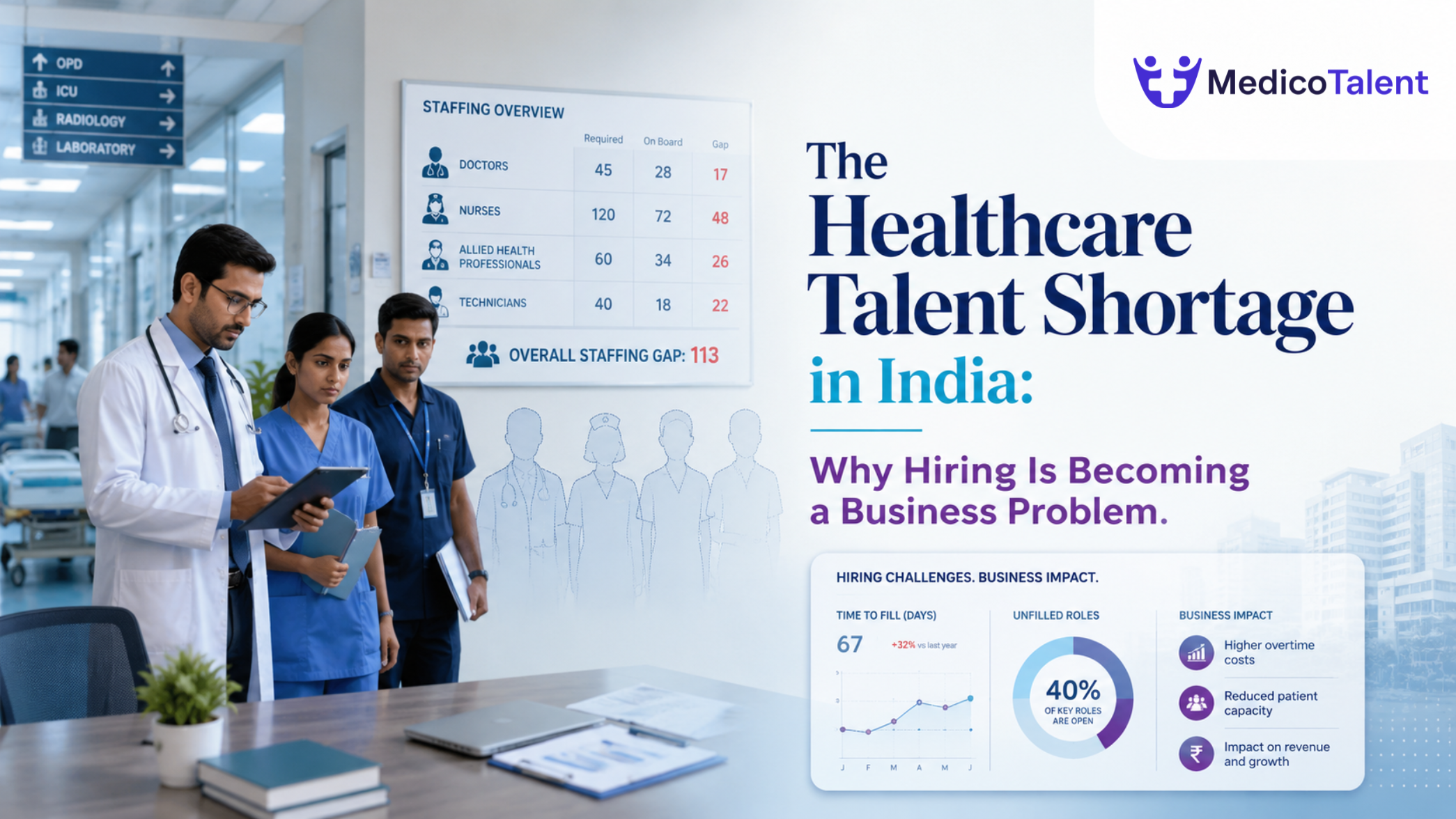
For a hospital planning to expand, the difficult part may appear to be finding the capital, the building or the equipment. But once the new ward is ready, another constraint quickly becomes apparent: it needs people. Beds require nurses. Operating theatres require doctors and technicians. Diagnostic departments require laboratory and imaging professionals. Pharmacies need pharmacists, rehabilitation units need physiotherapists, and the growing administrative machinery behind modern healthcare requires its own specialised workforce.
This is where India's healthcare expansion runs into a problem that is easy to underestimate. The country is training more healthcare professionals than it did a decade ago, adding medical and nursing capacity and investing heavily in healthcare infrastructure. Yet employers across hospitals, clinics, diagnostic centres and other healthcare organisations can still struggle to find the right people for particular jobs, especially when experience, specialisation and location are taken into account.
What looks, from a distance, like a shortage of workers is often more complicated. It is a shortage of the right worker, in the right place, with the right skills, at the moment an employer needs them. Increasingly, that is not simply a recruitment problem for India's HR departments. It is a constraint on how healthcare organisations grow and operate.
India Has More Healthcare Professionals. So Why Is Hiring Still Difficult?
India has expanded its healthcare training capacity considerably. The Ministry of Health and Family Welfare reported in February 2026 that the country had 13.88 lakh registered allopathic doctors and 39.40 lakh nursing personnel. It also reported 5,310 nursing institutions producing nearly 3.82 lakh nursing professionals annually.
Those numbers suggest a workforce of enormous scale, and they reflect real progress. The World Health Organization similarly notes India's expansion of medical and nursing education, while also pointing to the continuing need for more training, faculty development and advanced specialties to meet the country's changing health needs.
The apparent contradiction begins to make sense when national totals are separated from the reality of recruitment. A registered professional is not necessarily an available candidate. Someone who is available nationally is not necessarily available locally. And a qualified healthcare professional is not necessarily qualified for the precise vacancy that a particular hospital needs to fill.
Consider a hospital looking for an experienced ICU nurse in one city. The national supply of nurses tells its recruitment team very little about how many people with critical-care experience live within reach of the hospital, how many are currently seeking a job, how many would relocate, or whether the salary and working conditions are attractive enough to persuade them to move. A workforce can therefore look large on paper while becoming surprisingly small once an employer applies the requirements of an actual vacancy.
That difference between workforce supply and usable talent supply is increasingly important for healthcare organisations.
There Is No Single Healthcare Talent Pool
Healthcare recruitment is particularly difficult because healthcare workers are not interchangeable. A shortage of one category cannot automatically be solved by an abundance in another, and even professionals within the same broad category may have very different skills and experience.
A hospital may have little difficulty finding applications for a general nursing role while struggling to recruit someone with extensive critical-care or operating-theatre experience. A diagnostic centre might require a technician familiar with particular procedures or equipment. A specialist hospital may need doctors in disciplines where the local pool is limited. Rehabilitation centres, dental practices, pathology laboratories, pharmacies and home healthcare providers each draw from different sections of the healthcare workforce.
This creates hundreds of smaller labour markets within the larger healthcare labour market. Each has its own qualifications, registrations, experience requirements, salary expectations and geographical patterns. For an HR department, the question is therefore rarely whether India has enough healthcare professionals in the abstract. The question is whether enough suitable professionals can be identified and reached for the vacancy that exists today.
The distinction matters because recruitment statistics can be deceptive. A vacancy that generates 300 applications may appear to have performed exceptionally well. If only a handful of those applicants possess the required healthcare background, however, the employer has not really solved its recruitment problem; it has created a screening problem.
Geography Makes the Problem Harder
Healthcare also has a characteristic that distinguishes it from many parts of the modern economy: most of the work still has to happen somewhere specific. A software developer may work for a company hundreds of kilometres away. A nurse caring for patients in a hospital generally cannot.
That makes the distribution of healthcare professionals almost as important as their absolute number. A country can have a substantial healthcare workforce and still experience serious local shortages when professionals cluster around particular cities, institutions or employment markets. WHO has long identified unequal distribution alongside overall workforce availability as an important part of India's health workforce challenge.
For employers outside major urban centres, this can turn an ordinary recruitment exercise into a national search. A hospital may find a qualified candidate in another state, but then another series of questions begins. Is the person willing to relocate? Is the salary sufficiently attractive once housing and living costs are considered? Does the organisation provide accommodation? What opportunities exist for career progression? Will the employee remain once a more convenient position becomes available elsewhere?
Recruitment, in other words, does not end with discovering a candidate. Employers must also persuade that person that the opportunity is worth accepting.
This is one reason healthcare talent shortages cannot be solved only by producing more graduates. Training determines how many professionals enter the potential workforce. Recruitment, mobility and retention determine where those professionals eventually work.
An Empty Position Has a Business Cost
For years, recruitment has often been treated as a support activity: a necessary function carried out by HR so that the rest of the organisation can continue with its work. In healthcare, that distinction is becoming harder to maintain because labour is inseparable from the service being sold.
A hospital can purchase another MRI machine, but the machine does not operate itself. It can construct another floor, but additional beds have limited value if staffing levels make them difficult to use. A healthcare group can enter a new city, but opening a facility requires recruiting an entire ecosystem of clinical and non-clinical employees.
The financial consequences of an unfilled position are not always captured by the recruitment budget. There may be overtime costs as existing workers cover gaps, administrative time spent repeatedly advertising and screening, delays in expanding departments and additional pressure on teams already working at capacity. In some circumstances, a workforce shortage can affect how much healthcare an organisation is practically capable of delivering.
That changes the economics of recruitment. The cost of hiring is no longer simply what an employer pays to advertise a vacancy or engage a recruiter. It also includes the cost of not hiring quickly enough.
For a healthcare organisation planning significant growth, this becomes especially important. Capital can expand infrastructure relatively quickly. Developing, attracting and retaining an experienced healthcare workforce can take much longer.
Expansion Creates Its Own Recruitment Problem
India's healthcare system is continuing to expand, with government policy increasing training capacity and healthcare infrastructure while digital health, diagnostics and new models of care widen the range of services being delivered. Recent government assessments describe substantial growth in medical education and continued investment in healthcare delivery.
But every expansion of healthcare capacity also creates new demand for labour. A new hospital does not simply require a few additional doctors. It may require nurses across multiple wards, pharmacists, laboratory staff, imaging professionals, physiotherapists, administrators, technicians and support personnel. Even a relatively small expansion can generate recruitment needs across several professional categories at once.
This means a growing healthcare sector can paradoxically make shortages more visible. Employers are not competing for talent against a fixed backdrop. New hospitals, expanding healthcare groups, diagnostic chains, specialist centres and other providers can all be recruiting from overlapping professional communities.
The candidate consequently gains more choice. A nurse comparing two hospitals may consider working hours, shifts, accommodation, salary, professional development and distance from home. A doctor may weigh clinical exposure, facilities and career prospects. A physiotherapist might choose between a hospital, rehabilitation centre and private clinic. A laboratory professional may compare several diagnostic employers.
Recruitment has therefore become a two-sided decision. The hospital is choosing the professional, but the professional is choosing the hospital too.
The Recruitment Problem Often Starts Before Anyone Applies
When employers struggle to hire, it is tempting to conclude that suitable candidates simply do not exist. Sometimes that is true. In highly specialised roles or certain locations, the available talent pool can genuinely be narrow.
But sometimes the candidates exist and never encounter the vacancy.
This is an important distinction in a fragmented online recruitment market. A hospital can publish a vacancy on its own careers page, post it on social media and advertise it through a general employment website, yet still fail to reach many of the healthcare professionals who might plausibly consider the role.
General job portals offer scale, and that scale is useful for many employers. But healthcare vacancies compete there with openings in technology, banking, engineering, retail, hospitality, manufacturing, sales and numerous other industries. The central recruitment question is therefore not simply how many people were technically capable of seeing an advertisement. It is how many relevant healthcare professionals actually encountered it.
That is particularly important when HR teams are recruiting across several professions simultaneously. More applications are not necessarily a measure of better recruitment if the additional volume consists largely of candidates who do not meet the basic requirements. Every unsuitable CV still has to be opened, reviewed or filtered before the employer reaches the small group of people it wanted in the first place.
As the existing MedicoTalent analysis of hospital recruitment argues, the real value in healthcare hiring is often relevance rather than sheer application volume.
Retention Is Now Part of the Recruitment Equation
Finding new employees solves only one part of the workforce problem. Hospitals and healthcare organisations also have to keep the people they already employ.
This matters because high turnover can turn recruitment into a permanent replacement exercise. HR fills one vacancy only for another to appear elsewhere. Recruiters spend time sourcing, interviewing and onboarding candidates without producing a corresponding increase in the organisation's overall workforce because new hires are continually replacing departures.
The consequences extend beyond HR. When experienced employees leave, organisations can lose institutional knowledge and clinical experience alongside headcount. Remaining employees may take on additional work, making retention harder still. A recruitment shortage and a retention problem can therefore reinforce each other.
Employers trying to improve hiring may eventually have to look beyond recruitment channels and examine the job itself. Compensation, management, working conditions, scheduling, career progression, training and professional respect can all influence whether an employee stays. A compelling job advertisement may persuade someone to apply, but it cannot compensate indefinitely for an employment proposition that people do not want.
The most effective workforce strategy consequently begins before a vacancy appears. It asks not only how people will be recruited, but why good employees would choose to remain.
Healthcare Recruitment Is Becoming Business Infrastructure
For large healthcare employers, recruitment may need to be understood less as a sequence of individual vacancies and more as permanent organisational infrastructure. A hospital group recruiting throughout the year is not simply filling jobs; it is maintaining access to a labour market on which its operations depend.
That requires different questions. Which roles are consistently difficult to fill? How long do they remain vacant? Where do successful candidates come from? Which locations create the greatest recruitment difficulty? Which advertisements generate relevant applicants rather than merely large numbers of applicants? And which vacancies recur because employees are leaving?
These are business questions as much as HR questions because the answers influence expansion, costs and operational capacity. An organisation that knows it will require another 100 nurses during the next stage of growth cannot reasonably begin thinking about those nurses after the new capacity is already built.
Healthcare organisations also benefit from a broader recruitment network. Their own careers pages, employee referrals, specialist recruitment firms, educational institutions, professional communities, social media and healthcare-focused job platforms can serve different purposes. The objective is not necessarily to replace one channel with another, but to make it easier for an employer to reach the appropriate professional community when demand arises.
Where a Healthcare-Specific Platform Fits
MedicoTalent was developed around this narrower recruitment problem. Instead of treating healthcare as one employment category among many, the platform is organised around healthcare jobs and the professionals who fill them, including doctors, nurses, pharmacists, physiotherapists, laboratory professionals, imaging professionals, dentists, hospital administrators and other allied health workers.
A specialised platform does not make the underlying workforce constraints disappear. It cannot create an experienced specialist in a location where none is available, make an unattractive salary competitive or solve a hospital's retention problems. Nor should any credible job platform suggest that simply publishing an advertisement guarantees a hire.
What it can do is improve the starting point. A healthcare employer can place its vacancy in an environment designed around healthcare employment, while healthcare professionals can search for opportunities without navigating a much broader labour market. For organisations recruiting repeatedly, that additional route to relevant candidates can become one part of a larger workforce strategy.
That distinction is important. Technology is unlikely to solve India's healthcare talent shortage by itself, but it can make the labour market easier to navigate. Better visibility, clearer vacancies and more direct connections between employers and professionals can reduce some of the friction that turns an available workforce into an inaccessible one.
The Real Shortage Is Often a Shortage of Connection
India's healthcare workforce debate will continue to be expressed through national numbers: doctors per thousand people, nursing capacity, medical college seats, specialist vacancies and projections of future demand. Those figures are necessary because they tell policymakers whether the country is producing enough healthcare professionals and where investment may be required.
Employers experience the same problem on a much smaller and more immediate scale. They experience it when an ICU roster has another gap, when a laboratory cannot find the technician it needs, when a hospital expansion creates dozens of vacancies at once or when an HR manager spends another week searching for applicants who actually meet the requirements.
Both perspectives describe the same labour market, but from different ends. India needs enough healthcare professionals overall, and healthcare organisations need a better way to connect with the people who already exist.
The Ministry of Health can expand medical education. Nursing institutions can train hundreds of thousands of professionals. Hospitals can continue adding capacity. Yet none of those achievements removes the need to match individual people with individual jobs, in particular places, under conditions both sides are willing to accept.
That is why healthcare hiring is becoming a business problem. For an industry built almost entirely around human expertise and care, talent is not merely another input that can be purchased when required. It determines how much of the organisation's infrastructure can actually be used, how quickly it can expand and how reliably it can serve patients.
India's healthcare future will therefore depend on more than the number of hospitals it builds or the number of professionals it trains. It will also depend on whether those two sides of the system can find one another.
MedicoTalent is a healthcare-only job platform connecting healthcare employers with doctors, nurses and allied health professionals across India and international markets. Healthcare professionals can search and apply for opportunities directly, while hospitals, clinics, diagnostic centres and other healthcare organisations can advertise vacancies to a healthcare-focused audience.